What Is a Shear Baler and How Does It Work in Scrap Metal Recycling
26 June, 2026


In modern manufacturing and metal processing industries, scrap management has become an essential part of production efficiency and environmental compliance. Among the various technologies used to handle metal waste, the briquetting press has emerged as a highly effective solution. It transforms loose metal chips, turnings, and shavings into compact, dense briquettes that are easier to handle, store, transport, and recycle.
As industries continue to prioritize sustainability and cost reduction, briquetting technology plays an increasingly important role in closing the loop between production waste and material reuse.
A briquetting press is a machine designed to compress metal scrap into solid blocks without the need for binders or adhesives. Using high mechanical or hydraulic pressure, it compacts materials such as aluminum chips, steel turnings, copper scrap, and cast iron residues into dense briquettes.
These briquettes are not only easier to manage but also more valuable in the recycling chain compared to loose scrap. By reducing volume and removing excess cutting fluids or oils, the machine significantly improves both logistical efficiency and material recovery rates.
Metalworking industries generate a large amount of scrap during machining processes such as turning, milling, drilling, and grinding. These by-products are often lightweight, bulky, and contaminated with lubricants or coolant fluids.
Without proper handling, this type of waste can create several challenges:
High storage requirements in production facilities
Increased transportation costs due to low density
Loss of valuable cutting fluids
Inefficient melting and recycling processes
A briquetting press addresses these problems by converting waste into a standardized, high-density format that is more suitable for recycling operations.
The automotive industry is one of the largest users of metal processing equipment, which naturally leads to significant scrap generation. Engine parts, transmission components, and chassis elements are often machined from steel or aluminum alloys, producing continuous chips and turnings.
By integrating briquetting presses into production lines, automotive manufacturers can:
Reclaim valuable cutting fluids from metal chips
Reduce scrap storage space on the shop floor
Improve furnace efficiency during remelting
Lower transportation frequency to recycling centers
In many cases, briquetted metal scrap can be sold at a higher price due to its purity and density, making it a financially attractive solution.
Aluminum is widely used in packaging, construction, and transportation industries. During machining and die casting, aluminum chips are produced in large quantities. These chips are lightweight and highly reactive when exposed to air or moisture.
A briquetting press helps aluminum processors by:
Reducing oxidation risks through compact storage
Recovering coolant and lubricants for reuse
Increasing melting efficiency in foundries
Minimizing scrap volume by up to 90%
The improved density of aluminum briquettes also allows for more stable and predictable melting behavior, which is critical in high-precision casting applications.
Steel and cast iron machining generates heavy, sharp, and often tangled chips. These materials are difficult to handle in loose form and can occupy large storage areas.
Briquetting presses are widely used in steel workshops and foundries to:
Convert irregular chips into uniform briquettes
Reduce oxidation during storage
Improve furnace charging efficiency
Lower energy consumption in remelting processes
For cast iron, in particular, briquetting helps preserve carbon content and reduces material loss during recycling, which improves the overall quality of reused metal.
CNC machining centers are one of the most common sources of metal scrap in modern factories. High-speed machining operations produce continuous chips mixed with cutting oil or coolant.
Integrating a briquetting press into CNC production environments offers several advantages:
Continuous waste handling directly from machine output
Cleaner workshop environments
Reduced fire hazards caused by oil-soaked chips
Recovery of expensive cutting fluids for reuse
In advanced manufacturing setups, briquetting systems are often connected directly to chip conveyors, forming a semi-automated waste management system.
Beyond operational efficiency, briquetting technology contributes significantly to environmental sustainability. Metal recycling is already an energy-saving process compared to primary metal production, but briquetting enhances this benefit further.
Key environmental advantages include:
Reduction in landfill waste
Lower carbon emissions during transport and melting
Efficient recovery of industrial lubricants
Support for circular economy practices
By compacting scrap into reusable forms, industries can reduce their ecological footprint while complying with stricter environmental regulations.
The financial benefits of using a briquetting press are often just as important as the operational improvements. Companies that implement this technology typically experience:
Lower transportation costs due to reduced volume
Increased scrap resale value
Reduced coolant and oil consumption
Lower energy usage in melting processes
Decreased waste handling labor costs
Over time, these savings can offset the initial investment in briquetting equipment, making it a cost-effective long-term solution.
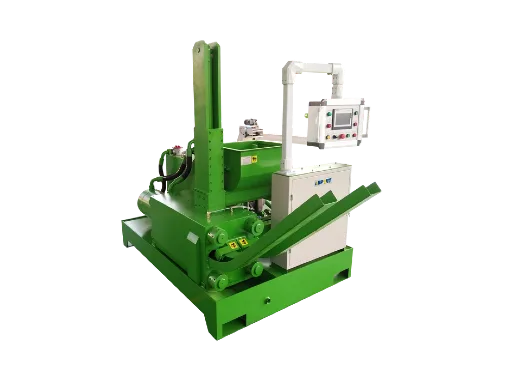
Today’s recycling facilities are increasingly automated and data-driven. Briquetting presses are often integrated into broader metal recovery systems that include shredders, conveyors, separators, and melting furnaces.
In such systems, briquetting serves as a critical intermediate step that stabilizes scrap quality before it enters the recycling furnace. This ensures more consistent melting performance and higher-quality recycled metal output.
While briquetting technology offers many benefits, proper implementation requires careful planning. Some key considerations include:
Selecting the right machine capacity for production volume
Matching press type with material characteristics
Ensuring proper removal of contaminants before pressing
Maintaining hydraulic and mechanical systems regularly
Training operators for safe and efficient use
Failure to address these factors can reduce machine efficiency or lead to inconsistent briquette quality.
As industries move toward smarter manufacturing and greener production methods, briquetting technology is expected to evolve further. Future developments may include:
Fully automated chip-to-briquette systems
AI-based monitoring of press performance
Integration with IoT-based production tracking
Improved energy efficiency in hydraulic systems
These innovations will make briquetting even more essential in modern metal recycling infrastructure.
The industrial applications of briquetting presses in metal scrap recycling extend across multiple sectors, from automotive manufacturing to CNC machining and aluminum processing. By transforming loose metal waste into dense, manageable briquettes, this technology improves efficiency, reduces environmental impact, and enhances economic returns.
In an era where sustainability and resource optimization are becoming central to industrial operations, briquetting presses are no longer just auxiliary equipment—they are a key component of modern recycling systems.